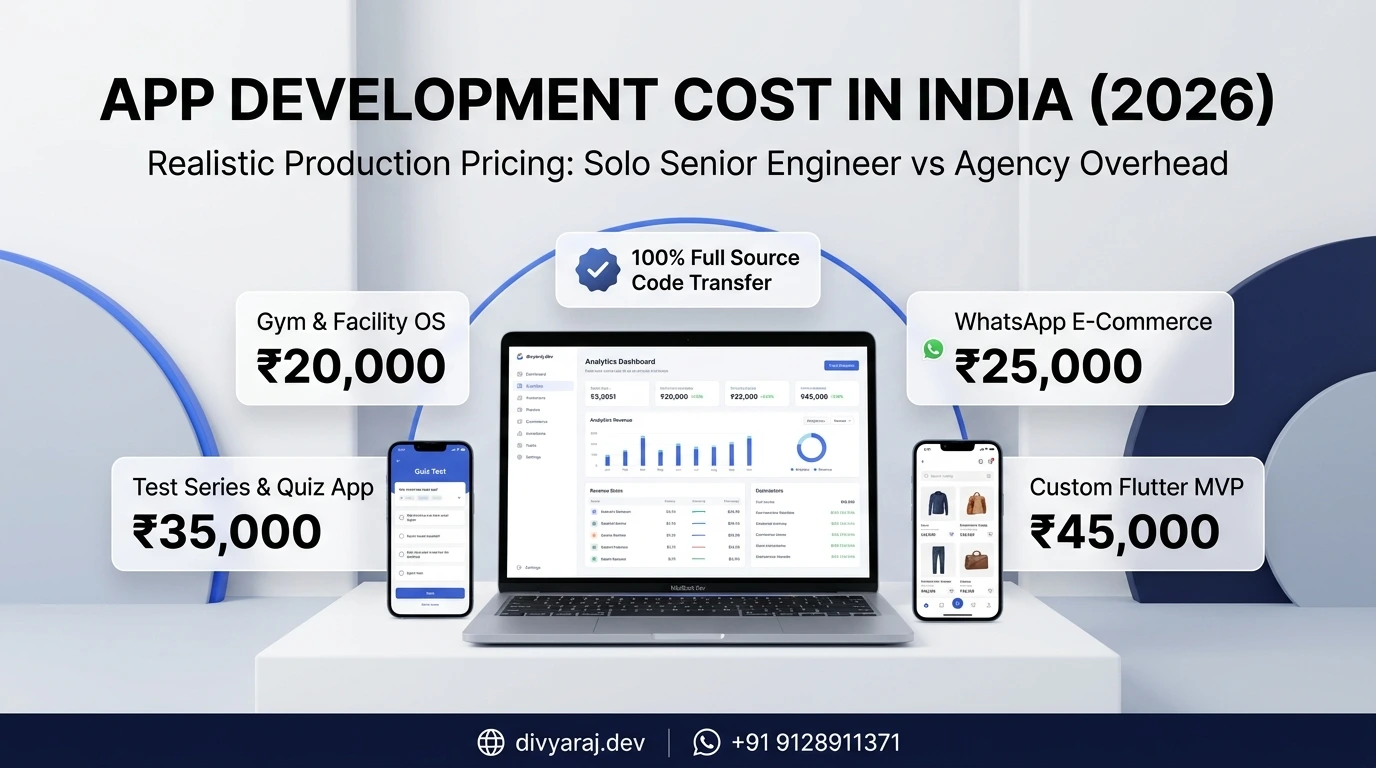
1. The 4 Production App Archetypes & Realistic Costs
Apps are not billed on hourly guesswork; they are scoped based on proven system architectures. If your requirements fit into one of these four battle-tested models, here are the direct engineering costs:
Designed for local fitness centers, martial arts academies, and member-based facilities.
- Member ID cards & profile logs
- Offline-first local SQLite caching
- 1-tap WhatsApp fee reminders & receipts
- Monthly revenue & expiry analytics
Clean product showcase app with direct WhatsApp ordering and zero recurring platform commissions.
- High-speed product catalog with search
- Cart to formatted WhatsApp message order
- Optional UPI / Razorpay payment gateway
- Zero monthly Shopify app subscription tax
Complete examination ecosystem for state boards, competitive test portals, or coaching institutes.
- Chapter-wise tests & 10,000+ PYQ engine
- Negative marking, timers & instant scoring
- Gamified XP points & live leaderboard
- Android APK + Web PWA included
Full-stack cross-platform software MVP built to acquire early traction and investor validation.
- Flutter (iOS + Android single codebase)
- Supabase or Firebase Auth & PostgreSQL
- Clean REST / GraphQL API routing
- Shipped and deployed in 2 to 3 weeks
2. Why Agency and Solo Developer App Costs Can Differ
When you request a quote from an IT agency in Bengaluru, Delhi NCR, or Mumbai for a test series or gym app, quotes routinely start at ₹1,50,000 to ₹3,50,000+. This pricing difference comes down to organizational overhead: agencies employ project managers, account executives, sales teams, and commercial office infrastructure, whereas a solo senior engineer charges purely for direct engineering output:
| Deliverable / Dimension | Traditional Software Agency | Solo Full-Stack Engineer |
|---|---|---|
| Cost Structure | ₹1.5L to ₹4.0L+ (includes PMs, HR, office lease) | ₹20k to ₹50k (pure engineering labor) |
| Delivery Timeline | 3 to 5 months (weekly status meetings) | 14 to 21 days (rapid direct deployment) |
| Communication | Filtered through non-technical account managers | Direct engineer access via WhatsApp/Call |
| Code Ownership | Often retained to lock you into costly retainers | 100% full source code ownership on final delivery |
| Quality Assurance | Often assigned to junior interns | Written and deployed by a senior builder |
3. Third-Party Infrastructure & Play Store Fees
Beyond the developer's build fee, every mobile application requires certain official third-party licenses. Here is the honest, zero-markup breakdown of what you pay directly to the platform providers:
- Google Play Console Account: $25 (approx ₹2,100) — One-time lifetime fee paid directly to Google. Required to publish Android apps.
- Apple Developer Program: $99/year (approx ₹8,300/year) — Only required if you intend to distribute to the Apple App Store for iPhones.
- Cloud Database & Auth (Firebase / Supabase): ₹0 / month to start. Generous free tiers allow most MVPs to launch at zero database cost. For example, Supabase includes up to 50,000 monthly active users for authentication and 500MB database storage, while Firebase provides daily document read/write quotas (50k reads, 20k writes/day) on its free Spark plan. You only pay when traffic exceeds these limits.
- Domain & Web Hosting (Optional): ₹800 to ₹1,200/year for a custom
.comor.indomain. Static landing pages can be hosted for free on Cloudflare Pages or Firebase Hosting.
4. 3 Red Flags When Hiring App Developers in India
Before wiring an advance payment to any freelance developer or agency, verify these three critical factors:
If a developer claims extensive mobile experience but cannot show a live, verifiable app on Google Play or TestFlight, they may only have built unverified local prototypes that have not passed Google Play's strict closed testing (such as the 12/20 testers mandate) or production compliance review.
Ensure your agreement guarantees the transfer of the full Flutter/Dart source code repository. If they refuse to provide raw code, you do not own your business software.
Agencies often lure clients with low hourly rates (e.g. ₹600/hr) and then report 400 hours of ambiguous "QA and integration" work. Always demand a milestone-based fixed scope price.
5. Frequently Asked Questions
Can my app be deployed to both Android and iOS?
Yes. By using Flutter, a single compiled codebase runs natively on both Android and iOS without doubling the engineering fee. The only difference is the requirement of an Apple Developer license ($99/yr) for App Store distribution.
How do payment milestones work?
Projects are structured into clear, fair milestones: 30% kickoff, 40% upon staging APK delivery (testing on your device), and 30% upon final store release and source code handoff.
What if my app needs custom features not listed in standard packages?
Every business has unique workflows. Share your feature list on a 15-minute discovery call, and you will receive a transparent, fixed-scope price proposal within 24 hours.