1. What Actually Determines AI App Development Cost?
Founders frequently ask why one development proposal arrives at $6,000 while another quotes $85,000 for the exact same initial concept. In software development, price is not determined by the label "AI"—it is driven by eight technical architectural choices:
| Architectural Driver | Lower-Cost Implementation | Higher-Cost Implementation |
|---|---|---|
| AI Model | Hosted APIs (OpenAI GPT-4o mini, Claude 3.5 Haiku) | Proprietary custom-trained or fine-tuned open-weights models |
| AI Functional Scope | Standard prompt completion / chat interface | Autonomous agentic workflows with multi-step tool calling |
| Context & Data | Zero-shot prompts / stateless API requests | Private Vector RAG pipeline with hybrid search & reranking |
| Backend Stack | Serverless BaaS (Firebase, Supabase pgvector) | Custom microservices & dedicated Kubernetes infrastructure |
| Target Platforms | Single codebase cross-platform (Flutter iOS + Android) | Separate native Swift (iOS) and Kotlin (Android) codebases |
| System Integrations | 1 to 2 standard third-party REST APIs (Stripe, Resend) | Multiple legacy ERPs, CRMs, and custom internal databases |
| Security & Compliance | Standard OAuth 2.0 / tokenized auth | Strict HIPAA, SOC 2 Type II, or GDPR zero-retention pipelines |
| Deployment Scale | Early-stage MVP capacity (<5k active users) | High-throughput production with load-balancing & fallback queues |
Many early-stage startups choose foundation model APIs rather than training custom models from scratch. Combining hosted APIs with clean application logic, vector retrieval, and a responsive mobile interface delivers 90% of the user value at a fraction of the capital expenditure.
2. AI App Costs by Project Archetype
When budgeting an AI application, requirements generally align with one of four core technical archetypes:
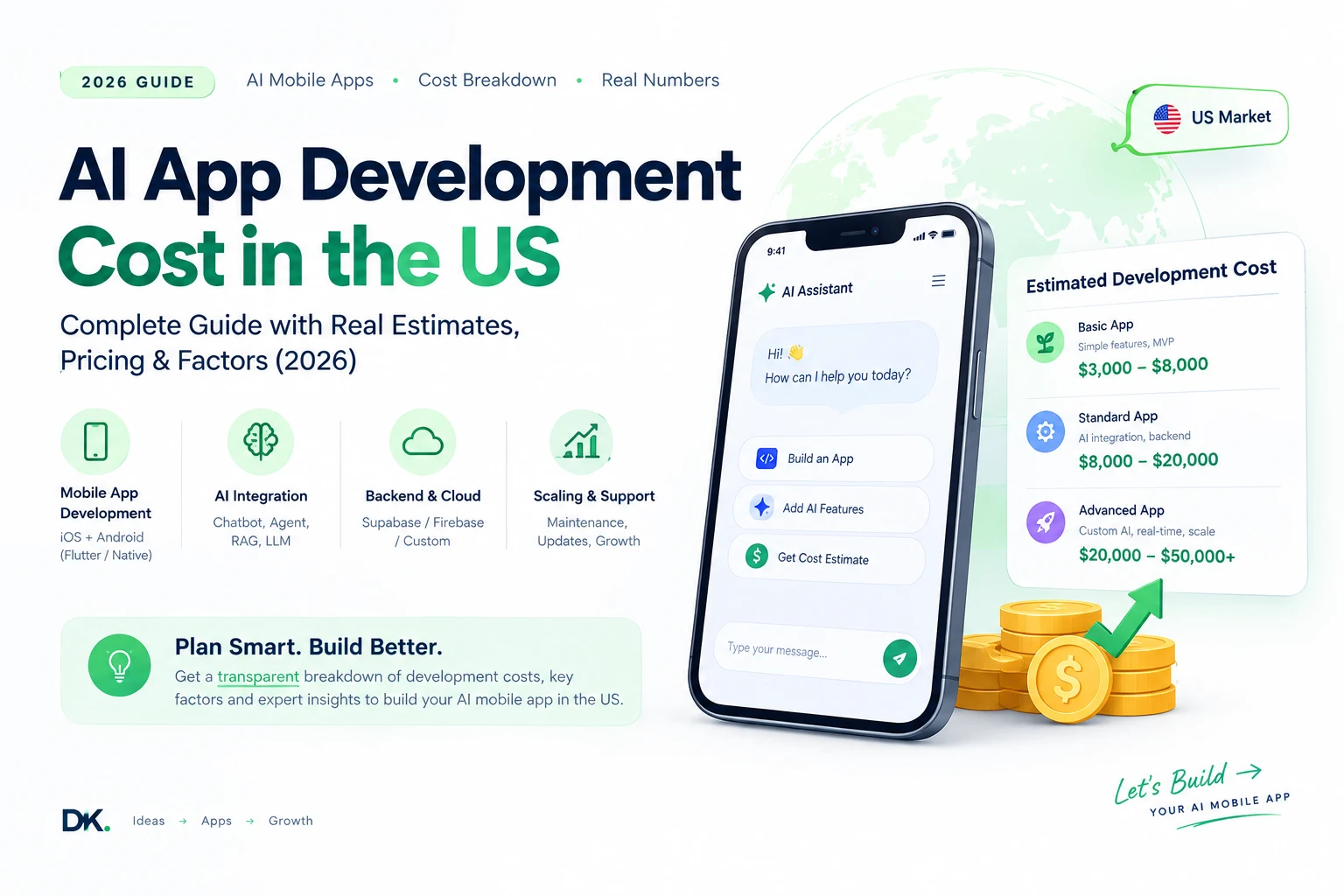
Single-purpose mobile applications processing structured user inputs through hosted prompt pipelines (e.g., AI resume editors, workout planners, image caption tools).
- 4–6 responsive mobile screens (Flutter)
- Hosted LLM integration (OpenAI / Claude API)
- Google/Apple Auth & RevenueCat paywall
- Turnkey store build ready for submission
- Vector search & private document embeddings
- Custom web admin dashboard
Intelligent assistants equipped with vector search and multi-session memory that accurately reference private knowledge bases or persistent user history.
- 7–10 polished mobile views (iOS & Android)
- Vector embeddings (Supabase pgvector / Pinecone)
- Streaming token responses (SSE) & markdown
- Persistent cross-session user chat memory
- Multi-tenant enterprise permission tiers
- Automated model fine-tuning pipelines
Goal-driven systems that plan, call external APIs, evaluate responses, and execute multi-step workflows autonomously without manual user intervention.
- Tool calling & function execution architecture
- Integration with 2–4 external APIs (CRMs, Calendars)
- Human-in-the-loop approval triggers
- Error recovery & fallback prompt loops
- On-premise self-hosted GPU clusters
- Complex voice-to-voice telephony protocols
Custom enterprise software requiring self-hosted open-weights models, multi-region database infrastructure, and stringent security compliance.
- Private cloud VPC deployment (AWS / GCP)
- Fine-tuned open-source models (vLLM / Ollama)
- SOC 2 / HIPAA compliance architectural auditing
- Granular Role-Based Access Control (RBAC)
Final cost scales directly with data pipeline volume and custom compliance audits.
3. Real Production Case Study: HmarAI Architecture
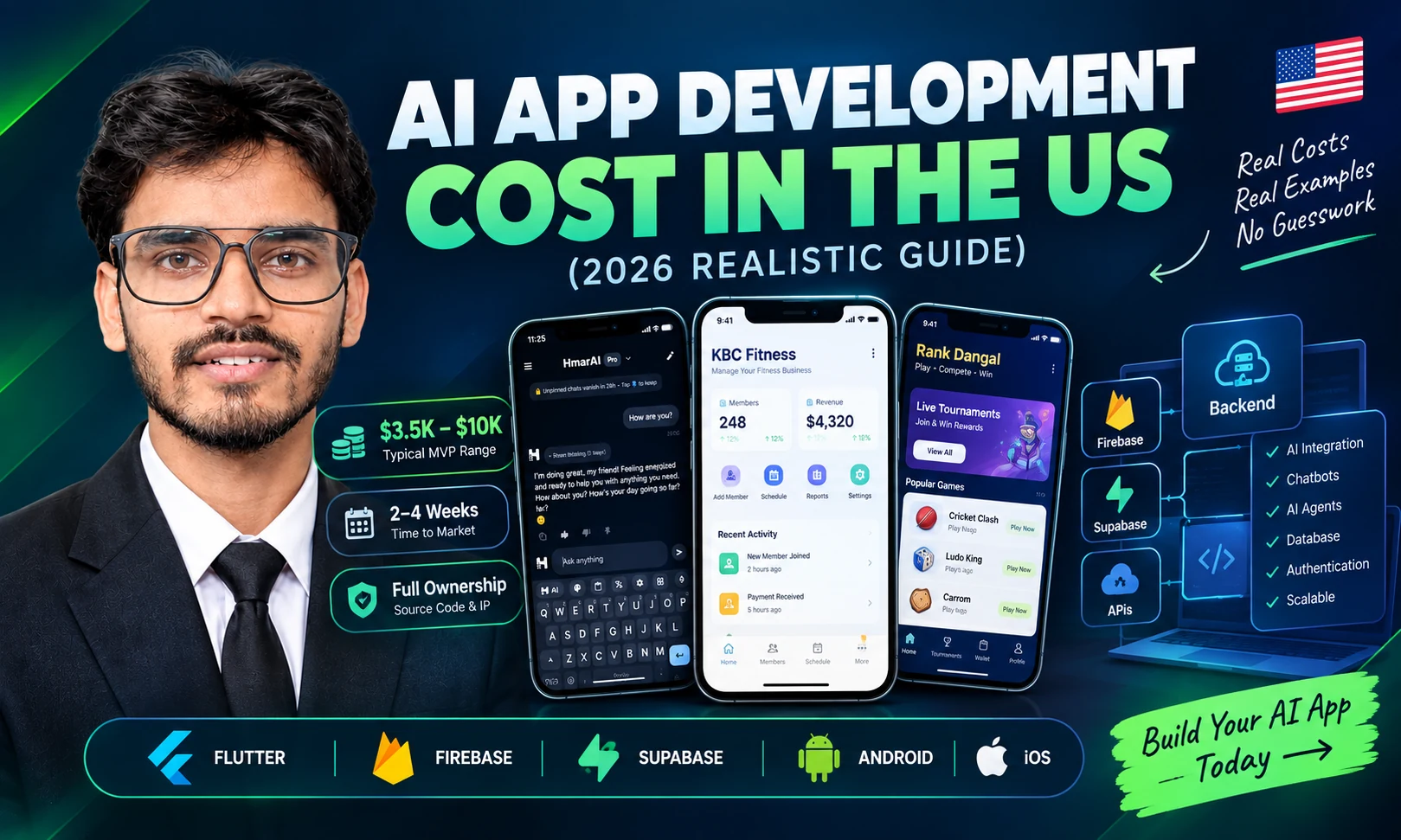
Cost discussions are only useful when anchored in verifiable engineering experience. When I designed and engineered HmarAI—a system-level Android keyboard and conversational AI assistant that retains persistent context across everything typed on a phone—we implemented the exact architectural patterns that dictate real-world build and maintenance costs:
- System-Level OS Integration: Rather than a standalone chat screen, HmarAI was implemented as a native Android Input Method Editor (IME) service in Kotlin. Building at the operating system layer required low-latency memory management to prevent keyboard freeze or UI frame drops.
- Sub-250ms Vector Retrieval: Notes, conversations, and personal context are converted into vector embeddings. When a user begins typing, a Retrieval-Augmented Generation (RAG) pipeline queries the vector store and streams suggestions back before user input concludes.
- Inference Optimization & Caching: Calling frontier LLMs on every single keystroke would cost thousands of dollars per day. By implementing local semantic caching in SQLite, redundant queries are intercepted locally, reducing server-side API expenses to under $15/month during beta testing.
4. Ongoing AI Operating Costs & Formula Assumptions
Beyond initial design and development, AI applications carry recurring operational expenses driven by foundation model token inference, database read/writes, and vector hosting.
To calculate realistic monthly operational expenses, we use the following standard estimation model:
Below is a baseline monthly operating budget for an application serving 1,000 Daily Active Users (DAUs) based on these explicit assumptions:
- Usage Intensity: 8–10 AI interactions per active user per day.
- Model Tier: Lightweight, high-speed foundation models (e.g., OpenAI GPT-4o mini, Anthropic Claude 3.5 Haiku, Google Gemini 1.5 Flash).
- Payload: Text-only queries (average 400 input tokens, 250 output tokens); no heavy multi-modal video/voice generation.
- Cache Hit Rate: 25% of common queries resolved via local or server-side cache.
| Operating Component | Representative Provider | Estimated Monthly Burn (1k DAUs) | Architectural Notes |
|---|---|---|---|
| LLM Token Inference | GPT-4o mini / Claude 3.5 Haiku | $35 – $110 / mo | Lightweight models provide sub-second latency at ~10% the cost of flagship models. |
| Vector Database (RAG) | Supabase (pgvector) / Pinecone | $0 – $25 / mo | Supabase free tier includes native pgvector up to 500MB of embedded vector data. |
| Cloud Backend & Auth | Firebase Spark / Supabase Free | $0 – $25 / mo | Covers authentication, JSON storage, and real-time syncing for early-stage user traffic. |
| Store Licenses | Apple ($99/yr) + Google ($25 one-time) | ~$10 / mo | Mandatory direct platform distribution fees. |
| Crash & Observability | Sentry / Firebase Crashlytics | $0 / mo | Generous free tiers cover error monitoring for apps under 50k monthly sessions. |
| Total Ongoing Burn | — | $45 – $170 / month | Predictable and directly tied to active user engagement. |
*Pricing and provider quotas are estimates based on published September 2026 documentation. Model pricing and cloud tiers evolve frequently; verify current provider pricing before finalizing financial plans.
5. Agency vs. Solo Engineer: Why Quotes Vary So Much
When US startups request proposals for an AI mobile application, agency bids commonly range from $60,000 to $200,000+, while experienced senior solo developers quote $4,500 to $12,000 for a comparable functional MVP.
This pricing difference does not reflect code quality—it reflects fundamentally different organizational models:
| Evaluation Dimension | Traditional Software Agency | Direct Senior Product Engineer |
|---|---|---|
| Cost Model | $60,000 – $200,000+ | $4,500 – $12,000 (Milestone-based) |
| Personnel Structure | Project Manager, Account Exec, UX Lead, QA, Junior Devs | 1 Senior Full-Stack Engineer (Direct builder) |
| Delivery Velocity | 12 to 24 weeks (layered sprint cycles) | 2 to 4 weeks (focused, direct execution) |
| Communication Path | Filtered through non-technical project managers | Direct technical collaboration via Slack & Loom |
| Best Suited For | Enterprise firms requiring large committee approvals | Early-stage founders needing rapid market validation |
Higher agency pricing reflects valid organizational requirements: agencies provide redundancy, dedicated project management, formal quality assurance teams, design research, and commercial infrastructure. For early-stage startups seeking to validate product-market fit before raising institutional capital, working directly with a solo senior engineer provides the agility needed to ship quickly without exhausting runway.
6. Founder's Vetting Checklist Before Hiring an AI Developer
Before committing advance capital to any engineering partner, use these four technical vetting criteria:
-
Demand Verifiable Deployment Evidence:
Ask for at least one live app published on Google Play or Apple TestFlight. Inquire about specific review challenges encountered during store compliance—such as Google Play's 2026 closed testing mandate—and how they resolved them. -
Inspect Latency Mitigation Techniques:
Ask how they handle LLM response latency on mobile connections. A qualified mobile engineer should immediately detail Server-Sent Events (SSE) streaming, optimistic UI state rendering, and local fallback caching. -
Ensure Direct Account Ownership:
Ensure all third-party services—OpenAI, Anthropic, Supabase, Google Cloud, and Firebase—are registered under your company email. Never permit an external vendor to hold your master API keys. -
Verify Token Cost Guardrails:
Confirm that prompt truncation, per-user rate limiting, and maximum daily spend caps are implemented in backend code before public distribution.
7. Example Real-World Project Scopes
To help founders map concepts to realistic budgets, here are three representative project specifications:
Example A: Real Estate Assistant (Contextual RAG) — ~$6,500
A cross-platform Flutter mobile app allowing property buyers to ask conversational questions regarding 5,000+ local property disclosures and architectural PDFs.
- Flutter iOS + Android frontend with streaming markdown chat
- Supabase PostgreSQL backend with pgvector embeddings
- Document ingestion pipeline extracting text from uploaded PDFs
- Delivered and tested in 18 business days
Example B: Fitness & Nutrition AI Coach — ~$4,500
A consumer health app providing daily personalized workout suggestions and macro calculations based on user profile logs and progressive gym stats.
- Flutter frontend with local SQLite offline progress tracking (similar to KBC Fitness)
- Prompt-chained API integration with Claude 3.5 Haiku
- RevenueCat in-app subscription integration
- Delivered in 14 business days
8. Frequently Asked Questions
Can a single senior engineer deliver an entire mobile app and AI backend?
Yes. In 2026, modern cross-platform frameworks like Flutter allow one engineer to build iOS, Android, and Web applications simultaneously from a single codebase. Coupled with serverless backends like Supabase or Firebase, an experienced full-stack engineer moves faster than an agency team with multiple handoffs.
How do you handle US startup timezones and collaboration?
I maintain dedicated daily working overlap with US timezones (EST and PST), utilizing async Loom video walkthroughs, shared Linear/GitHub boards, and direct Slack communication for real-time feedback.
Do you sign standard US NDAs and IP assignment agreements?
Yes. Prior to reviewing proprietary specifications, we execute a mutual Non-Disclosure Agreement (NDA) and Proprietary Information and Inventions Agreement (PIIA), ensuring full ownership of all code, intellectual property, and design assets transfers to your company.
What is the typical payment structure for fixed-scope MVPs?
Projects follow clear, equitable milestones: 30% kickoff upon contract signing, 40% upon staging APK / Apple TestFlight delivery (functional build on your device), and 30% upon final store deployment and complete source code repository handover.