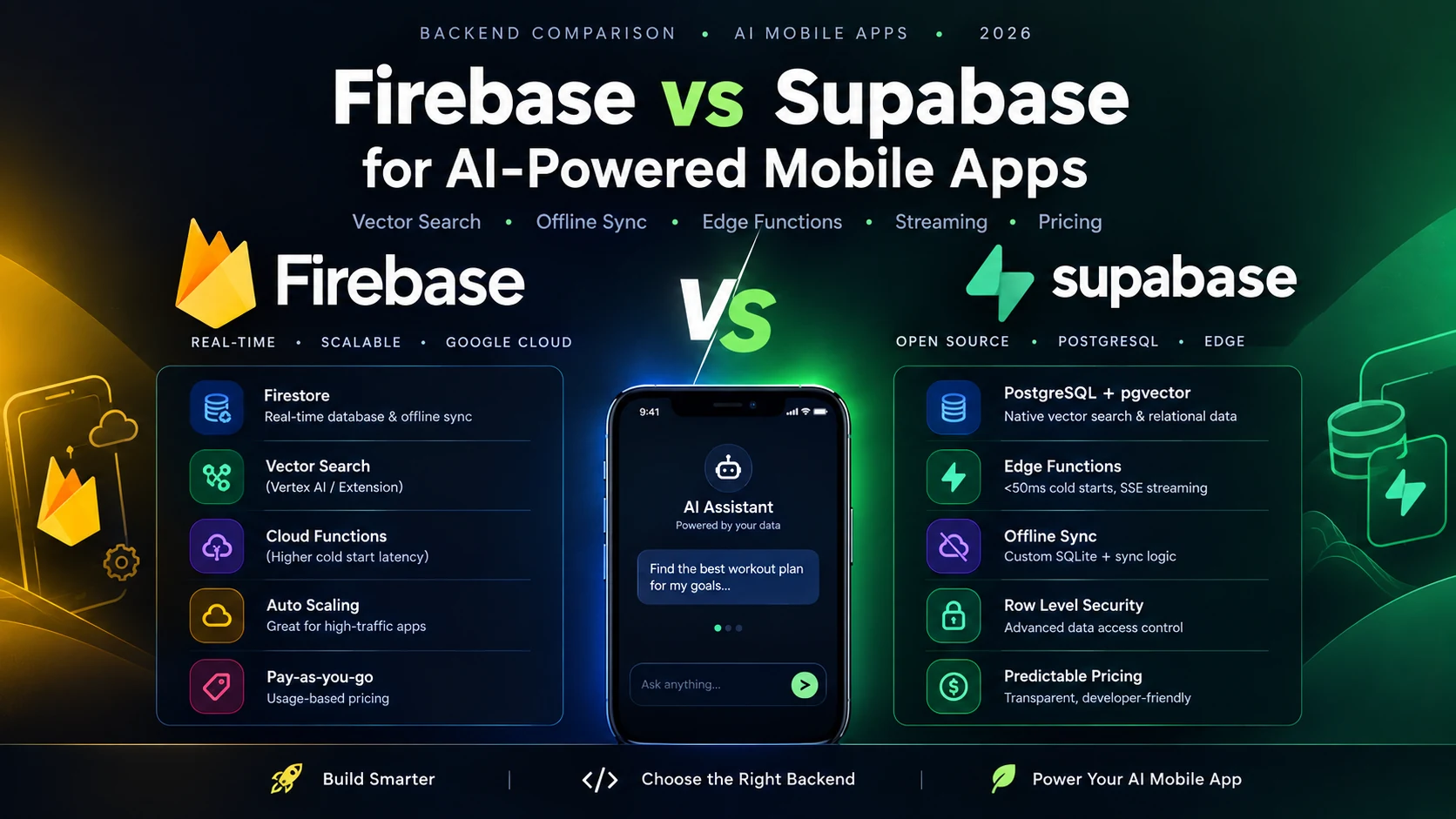
1. Head-to-Head Comparison Matrix
When building an AI mobile application with cross-platform frameworks like Flutter, your backend must handle vector similarity searches, user session state, and streaming token proxies without adding hundreds of milliseconds of overhead:
| Evaluation Dimension | Supabase (PostgreSQL) | Google Firebase (Firestore) |
|---|---|---|
| Database Model | Relational PostgreSQL 15+ | NoSQL Document Store (Firestore) |
| Vector Search (RAG) | Native pgvector (HNSW & IVFFlat indexes in SQL) |
Native Firestore Vector Search (KNN) or Vertex AI integration |
| Serverless Execution & Cold Starts | Deno V8 Isolates; designed for low-latency execution at the edge | 2nd-gen Cloud Functions (Cloud Run); supports min-instances for warm states |
| LLM Token Streaming | Edge Functions support streaming / SSE patterns natively | 2nd-gen callable functions support streaming responses (sendChunk) |
| Offline Synchronization | Custom SQLite (Drift / local DB) + explicit sync reconciliation | Built-in offline persistence (last-write-wins conflict resolution) |
| Free Starter Tier | 50,000 Auth MAUs, 500MB DB, 500k Edge Invocations | 50k daily reads, 20k daily writes, 1GB storage (Spark Free Plan) |
| Vendor Coupling & Portability | PostgreSQL-based; easier database portability and self-hosting options | Greater coupling to Firestore / Firebase client APIs and Google Cloud primitives |
2. The Decision Is Often About Data Model, Not AI
Founders frequently approach this comparison asking: "Which backend has better AI capabilities?" In reality, the LLM provider (Anthropic, OpenAI, Google Gemini) is usually accessed via standard API calls or client-side SDKs and is virtually interchangeable. The harder architectural decision is where application state, permissions, retrieval data, and offline caches should live:
Flutter Client → Firestore Document Store → 2nd-gen Cloud Functions → AI APIs / Vertex AI
Centered around document trees, real-time listeners, and automatic on-device caching.
Flutter Client → Postgres Auth / RLS → Edge Functions → AI APIs → pgvector Tables
Centered around relational tables, SQL joins, pgvector embeddings, and granular Row Level Security.
If your application requires relational structures—such as users, teams, subscription tiers, gym workout logs, and vector embeddings all joined in single queries—PostgreSQL is inherently cleaner. Conversely, if your app is built around standalone document hierarchies with high-frequency collaborative sync, Firestore's document model remains exceptionally fast to ship.
3. Vector Embeddings: Supabase pgvector vs. Firestore Native Vector Search
In any modern RAG (Retrieval-Augmented Generation) mobile app, vector similarity search is the core engine that enables the AI to answer questions using user documents, gym routines, product catalogs, or chat memory.
Supabase: Native pgvector in SQL
Supabase allows you to enable the pgvector extension with a single SQL statement:
-- Enable pgvector in Supabase
CREATE EXTENSION IF NOT EXISTS vector;

-- Store document chunks alongside embeddings
CREATE TABLE document_embeddings (
  id BIGSERIAL PRIMARY KEY,
  user_id UUID REFERENCES auth.users NOT NULL,
  content TEXT NOT NULL,
  embedding VECTOR(1536) -- OpenAI text-embedding-3-small dimensions
);

-- Fast similarity search index using HNSW indexing
CREATE INDEX ON document_embeddings USING hnsw (embedding vector_cosine_ops);

CREATE OR REPLACE FUNCTION match_documents (
  query_embedding VECTOR(1536),
  match_threshold FLOAT,
  match_count INT
)
RETURNS TABLE (id BIGINT, content TEXT, similarity FLOAT)
LANGUAGE plpgsql AS $$
BEGIN
  RETURN QUERY
  SELECT
    document_embeddings.id,
    document_embeddings.content,
    1 - (document_embeddings.embedding <=> query_embedding) AS similarity
  FROM document_embeddings
  WHERE 1 - (document_embeddings.embedding <=> query_embedding) > match_threshold
  ORDER BY document_embeddings.embedding <=> query_embedding
  LIMIT match_count;
END;
$$;
The core architectural advantage here is co-location: your relational data (user accounts, payment tiers, creation dates) lives in the exact same table as your embeddings. This lets you combine vector similarity search with relational filtering in PostgreSQL, often simplifying a RAG architecture without external data sync.
Firebase: Native Firestore Vector Search
Firestore now supports native vector similarity search by storing embeddings directly in documents and querying them through KNN vector indexes. This can work well for applications already centered on Firestore, although the query model and indexing options differ from PostgreSQL + pgvector. Current documentation supports vector dimensions up to 2,048 using flat vector indexes, allowing you to run similarity queries without necessarily provisioning an external vector store.
4. Streaming Latency & Serverless Functions
For interactive AI mobile UX, fast time-to-first-token is critical; the target should be defined from measured end-to-end latency rather than an arbitrary threshold. Because mobile users are sensitive to perceived delays, your serverless execution layer must stream tokens efficiently.
Low-Latency Edge Execution & SSE Streaming
Supabase Edge Functions run on globally distributed Deno V8 isolates designed for low-latency execution at the edge. In my test environment, cold-start overhead was minimal; real-world latency varies by region, workload, and network. They provide clean streaming endpoints that proxy tokens directly from Claude, OpenAI, or Gemini to your Flutter frontend via Server-Sent Events (SSE).
2nd-Gen Cloud Functions & Streaming Support
Firebase 2nd-gen Cloud Functions run on Google Cloud Run. Cold-start latency can add noticeable overhead when instances scale from zero. Firebase supports minimum instances to keep latency-sensitive functions warm, at additional cost. Notably, 2nd-gen callable functions support streaming responses directly via response.sendChunk(), providing native token streaming without custom reverse proxies.
5. Offline Synchronization: Mobile Realities
Here is where Google Firebase displays its historical strength.
In our live production app Rank Dangal (Bihar Board MCQ app on Google Play with 4.1★ and 489 reviews), students frequently study on patchy 3G connections. Firebase Firestore provides built-in offline persistence with automatic synchronization; conflicting writes to the same document follow Firestore's documented last-write-wins behavior. Writes are queued locally in an on-device cache and synchronized seamlessly when connectivity resumes.
With Supabase, there is no automatic offline client database. To build an offline-first app on Supabase (like our KBC Fitness gym operating system), we pair Supabase with a local SQLite database (using Drift in Flutter), handling the sync reconciliation logic explicitly.
The Tradeoff: If your AI app is primarily an offline utility that uses AI for periodic processing, Firebase has an easier offline setup. But if your app is an interactive AI companion that requires internet connectivity for LLM inferences anyway, Supabase's database superiority and SQL joins often outweigh Firebase's offline advantage.
6. Pricing & Quotas: Where Usage-Based Costs Can Compound
Let us analyze what happens when your AI startup grows from 500 beta users to 25,000 active users:
Supabase Pricing at Scale
- Free Tier: Up to 500MB database storage, 50,000 monthly active users (MAUs), and 500,000 Edge Function invocations.
- Pro Plan: Starts at $25/month (8GB database storage, 100k MAUs, 2M Edge Function invocations, daily backups), with usage-based limits and separate compute considerations as workloads grow.
- Vector Storage: 100,000 embeddings (1,536 dimensions) occupy ~650MB of disk space, easily fitting into standard tiers before dedicated compute upgrades are required.
Firebase Pricing at Scale
Example pricing shown for us-central1; actual prices vary by location and usage.
- Free Tier (Spark Plan): 50,000 document reads/day, 20,000 document writes/day, 1GB storage.
- Blaze Plan (Pay-as-you-go in us-central1): Cloud Firestore Standard charges approximately $0.03 per 100k reads, $0.09 per 100k writes, and $0.01 per 100k deletes.
- Where Usage-Based Costs Can Compound: In conversational AI applications where mobile clients repeatedly query historical message logs or document context chunks, reads compound rapidly. A client querying 20 messages per conversational turn across 10,000 daily active users can generate millions of document reads per week, making caching layers and paginated queries essential.
7. Which Architecture Fits Your App?
Pick Supabase if you are building:
- An AI Companion, Chatbot, or Copilot requiring vector memory (RAG) directly alongside relational user tables.
- An app that searches PDFs, proprietary documentation, or product catalogs joined with relational business logic.
- A platform prioritizing SQL queries, relational data integrity, and PostgreSQL Row Level Security.
- A team seeking open-source database portability and self-hosting flexibility.
Pick Firebase if you are building:
- A Real-time Collaborative or Gaming App (like live multiplayer quizzes or collaborative canvas tools).
- An application where built-in automatic offline document caching is the primary user requirement.
- A product already anchored in the Google Cloud ecosystem (Google Analytics, Vertex AI, BigQuery).
Consider a Hybrid Architecture if:
You want Firebase client-side capabilities (Firebase Auth, FCM push notifications, Firestore offline document cache) paired with a specialized PostgreSQL / Supabase backend for complex vector similarity search and analytical queries.
8. Frequently Asked Questions
Which backend is better for an AI mobile app with RAG: Firebase or Supabase?
Both can support RAG. Supabase is particularly convenient when embeddings need to live alongside relational PostgreSQL data and you want SQL-based filtering with pgvector. Firestore also supports native vector similarity search via KNN indexes, so Firebase can be appropriate when the rest of the application already depends on Firestore.
How does offline data synchronization compare between Firebase and Supabase?
Firebase Firestore provides built-in offline persistence with automatic synchronization, where conflicting writes to the same document follow documented last-write-wins behavior. Supabase operates as standard PostgreSQL over REST/WebSockets, so offline-first mobile apps typically pair Supabase with a local SQLite database (such as Drift in Flutter) with explicit sync reconciliation.
Can I migrate from Firebase to Supabase later if our AI needs grow?
Migration is possible, but it is not simply a database export/import. Firestore's document model, security rules, indexes, listeners, and client-side offline behavior often need to be redesigned for PostgreSQL relational tables and Row Level Security.
Is Supabase reliable for high-traffic consumer mobile apps?
Yes. Supabase supports production workloads from early-stage startups through larger teams, with higher compute tiers, read replicas, and enterprise clustering options available as requirements grow.
How does Flutter integrate with both backends?
Both have first-class, official Flutter packages (supabase_flutter and firebase_core / cloud_firestore). Both support native iOS and Android compilation, background push notifications, and OAuth authentication.